
When AI Stops Being Just Software
Physical AI is taking AI out of the screen and into factories, robots and machines. Here’s what is happening in 2026, why it matters for manufacturing, and what comes next.
For the last few years, it has felt like artificial intelligence lived almost entirely inside our screens. It could write emails, generate images, analyse documents, write software and answer just about any question we threw at it.
Now something more interesting is happening. AI is starting to move into the physical world, into factories, warehouses, vehicles, robots and machines. Instead of simply generating information, AI systems are increasingly being developed to understand their surroundings, make decisions and take action in the real world. This emerging field is broadly being called Physical AI, and in 2026 it has become one of the more interesting conversations happening across robotics and manufacturing.
So, what exactly is Physical AI?
The simplest way to think about it is this: traditional AI mostly works with digital information, while Physical AI is designed to interact with the physical world. A conventional AI system might look at an image of a machine and tell an engineer that something appears to be wrong. A Physical AI system could potentially use cameras and sensors to observe the actual machine, understand its condition, decide what needs to happen and trigger a physical action. That difference is important because the physical world is considerably messier than the digital one. Parts are not always perfectly positioned, machines wear out, lighting changes, materials vary and unexpected things happen. A useful Physical AI system therefore needs to do much more than recognise patterns. It needs to perceive, reason and act within an environment that is constantly changing. In simple terms, Generative AI creates in the digital world. Physical AI interacts with the real one.
Why is everyone suddenly talking about it?
The idea of intelligent machines isn’t new. Robots have been working in factories for decades, sensors have been monitoring equipment for years, and manufacturers have been using computer vision and automation long before ChatGPT existed.
What has changed is the rapid convergence of these technologies.
AI models are becoming more capable, robotics is becoming more sophisticated, sensors are becoming cheaper and more powerful, edge computing is allowing machines to process information closer to where it is generated, and digital twins are making it possible to simulate increasingly complex physical systems. NIST’s 2026 roadmap for artificial intelligence and machine learning in smart manufacturing identifies areas such as advanced sensing, autonomous systems, robotics, digital twins, additive manufacturing, industrial analytics and supply-chain optimisation as important parts of the next generation of manufacturing. At the same time, the roadmap highlights challenges around data, system integration, reliability and trustworthy AI.
So the technology is getting exciting, but the engineering problem is still very real.
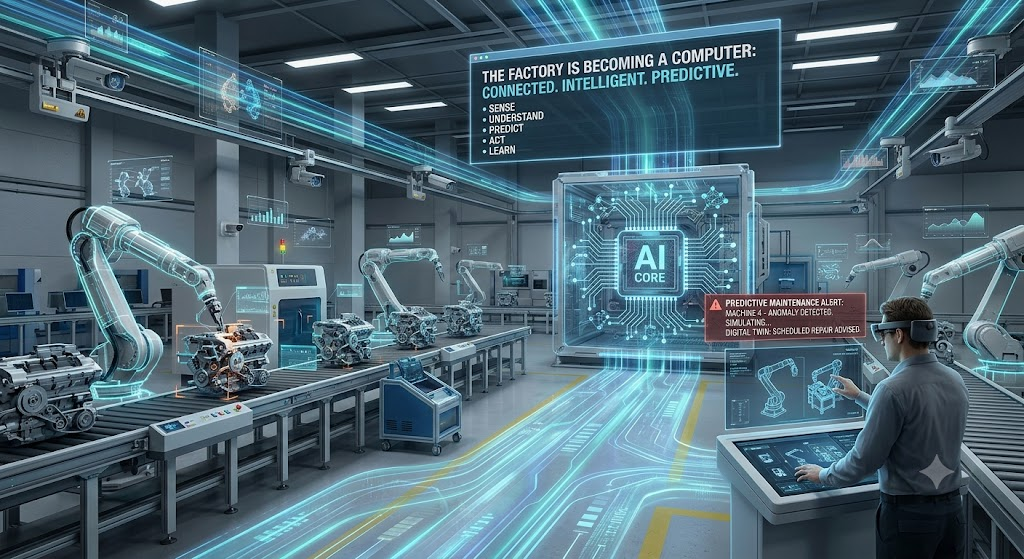
The factory is becoming a computer
Imagine a production line where cameras continuously inspect components while sensors monitor temperature, vibration and machine behaviour. An AI system notices that a machine is behaving slightly differently from its normal operating pattern and flags a potential issue.
A digital twin could then be used to simulate what might happen if the machine continues operating in that condition. An engineer could receive the information, investigate the cause and schedule maintenance before the machine actually fails. Individual pieces of this system already exist today. The bigger opportunity is connecting them into one continuous feedback loop.
Instead of manufacturing simply being a sequence of machines performing predefined operations, it starts to become a system that can sense, understand, predict, act and learn.
And robots are getting smarter too
Industrial robots are nothing new. Automotive factories, for example, have relied on robotic arms for welding, painting, assembly and material handling for decades.
The difference is that traditional industrial robots are generally extremely good at performing specific tasks in controlled environments. They can repeat the same movement thousands of times with incredible precision, but they usually don’t have much freedom to deal with situations outside the conditions they were programmed for.
Physical AI is trying to change that.
Instead of simply telling a robot where to move and what to pick, researchers and companies are working toward systems that can use cameras and other sensors to understand their environment, interpret instructions, choose actions and adapt when something doesn’t go according to plan. That sounds simple when written in one sentence. In reality, it is an extremely difficult engineering problem. Teaching a robot to pick up a component from a known location is one thing. Teaching it to recognise that the component has fallen over, determine where it is, work out how to safely grasp it and recover from the unexpected situation is something entirely different.
That is where the distinction between automation and intelligence becomes interesting.
Why humanoid robots are getting so much attention
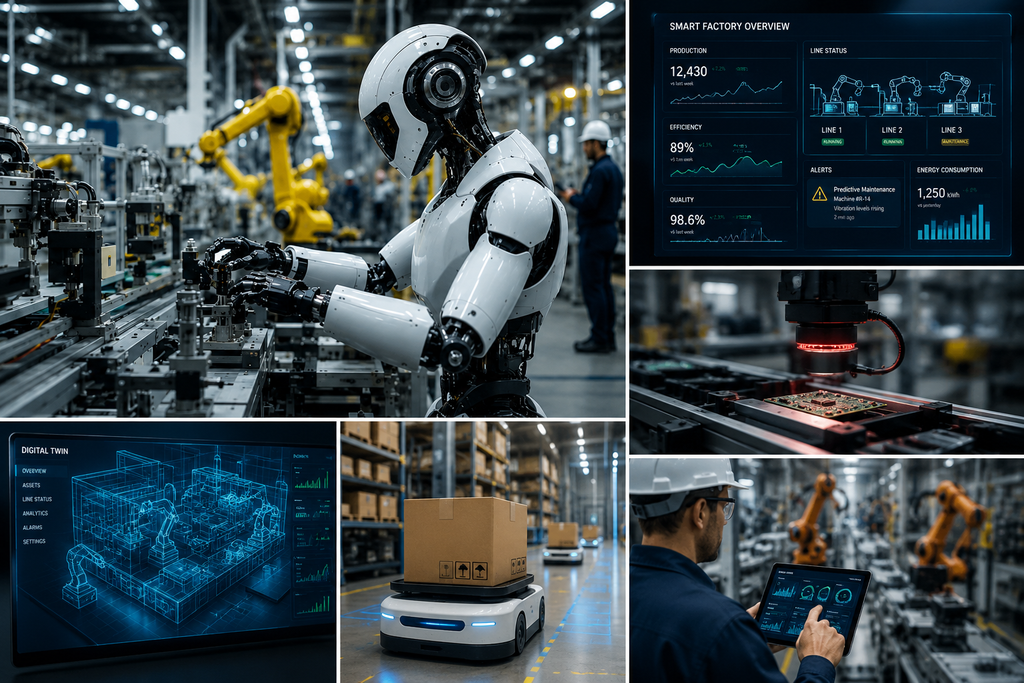
You may have noticed that humanoid robots have suddenly become much harder to ignore. At the 2026 World Robot Conference in Beijing, more than 300 companies showcased over 2,000 robotics exhibits, with more than 150 product launches. Demonstrations included humanoid robots performing tasks such as parcel sorting and electronics assembly.
The important question is no longer simply whether a robot can walk, balance or wave at a camera.
The real question is: Can it do useful work reliably and economically?
That question is still very much unanswered for many applications. But the direction of the industry is clear. Robotics is moving beyond highly controlled industrial environments and towards machines that can operate in more variable environments and perform a wider range of tasks.
There’s serious money behind the idea
Physical AI is also attracting significant investment.
According to PitchBook data reported by Business Insider, investment in robotics and Physical AI companies grew from around $4 billion in 2019 to $26 billion in 2025, with more than $23 billion raised by companies in the sector during 2026 so far. Of course, investment numbers don’t guarantee that every robotics or Physical AI company will succeed. Robotics is notoriously difficult because companies have to solve both software and hardware problems, while also dealing with manufacturing costs, safety, reliability and deployment.
But the investment does tell us something important: Physical AI has moved beyond being a niche research topic. It is increasingly being treated as a major technology category.
What about India?
This is where the story becomes particularly interesting. India already has several of the ingredients needed to participate in the Physical AI transition: a large manufacturing base, a strong engineering talent pool, a growing AI ecosystem and companies working across electronics, automotive, aerospace, industrial equipment and robotics.
The bigger challenge is connecting these capabilities.
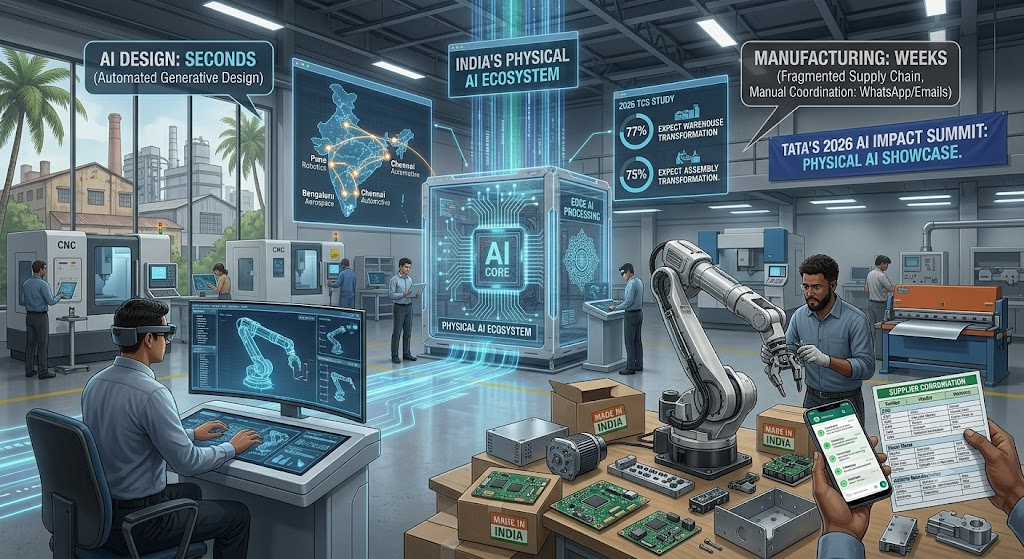
Indian industry is already discussing Physical AI as the next stage of AI adoption, with particular attention being paid to edge AI — processing intelligence closer to machines and devices so that systems can respond quickly without constantly relying on the cloud.The conversation is also moving beyond research. Tata’s 2026 AI Impact Summit showcase, for example, highlighted concepts involving AI-powered factory layouts, digital twins and human-AI collaboration in manufacturing. And the expectations from manufacturers are significant. A 2026 TCS study found that 75% of manufacturers expect Physical AI to significantly transform assembly and manufacturing operations, while 77% expect significant transformation in warehouse operations.
That doesn’t mean factories are about to become fully autonomous overnight. It does show that manufacturers are beginning to think seriously about how AI could change physical operations.
But here’s the part people don’t talk about enough
Everyone loves talking about the robot. Much less attention goes to everything around it. A robot still needs components. It needs sensors, motors, brackets, enclosures, PCBs, fixtures and tooling. Those parts need to be designed, manufactured, inspected, assembled and tested. And if a company is building a sophisticated physical product, those parts may come from completely different manufacturing processes and suppliers. A robotics startup might need CNC machining for one component, sheet-metal fabrication for another, PCB assembly for the electronics, additive manufacturing for an early prototype and specialised finishing for another part.
The technology inside the product may be incredibly sophisticated, while the process of getting all of its physical pieces together can still depend on emails, spreadsheets, phone calls and WhatsApp messages. That contrast is easy to overlook.
AI can design a part in seconds. Manufacturing still takes time.
This is one of the more interesting contradictions emerging in the hardware industry. AI is making many parts of engineering dramatically faster. Engineers can explore concepts more quickly, automate repetitive design tasks, analyse large amounts of data and use increasingly capable simulation tools. But eventually, someone still has to make the thing. A CNC machine has to cut the part. A fabricator has to bend the sheet metal. A PCB has to be assembled. Someone has to inspect the result. Someone has to put everything together.
For a hardware startup, the journey from an idea to a working product can involve CAD, prototyping, machining, fabrication, electronics, finishing, assembly and testing. Each stage may involve a different supplier, process and timeline. And if there are dozens of parts coming from multiple suppliers, coordinating all of it can become a surprisingly large part of the engineering team’s job. The irony is that we are making the product development process more digital while the manufacturing process can still remain highly fragmented.
The real opportunity might be the connection
This is perhaps the most interesting part of the Physical AI story. The future isn’t only about building smarter machines. It may also be about connecting the systems and people around those machines.
Consider a hardware startup developing a robot. Its journey might look something like this:
Concept → CAD → Prototype → CNC → Sheet Metal → PCB → Assembly → Testing → Field Data → Design Changes → Prototype Again
Every arrow in that chain represents coordination.
Someone needs to find the right supplier. Someone needs to send drawings. Someone needs to confirm specifications. Someone needs to track production. Someone needs to check quality. Someone needs to coordinate logistics and, eventually, someone needs to bring all the pieces together. Today, many of these activities still happen across disconnected tools and conversations. That creates a fascinating opportunity for the next generation of manufacturing software and services.
The next manufacturing layer may be about coordination
If AI is going to make physical products smarter, the infrastructure around making those products will need to become smarter as well. That doesn’t necessarily mean replacing factories or building one giant automated facility. It could mean connecting specialised manufacturing capabilities so that engineers and product companies can move from design to physical production with far less friction.
The long-term vision could look something like:
Design ↔ Manufacturing ↔ Quality ↔ Assembly ↔ Logistics ↔ Engineering
Instead of each stage operating as a separate island, information could flow between them. That could make product development faster, improve traceability and allow engineering teams to iterate much more quickly.
Does Physical AI mean fewer engineers?
Probably not in the simplistic way that headlines sometimes suggest.
Factories will still need people who understand machines, materials, processes, safety and engineering trade-offs. Someone still needs to decide what should be automated, validate the results and understand what to do when an AI system encounters a situation it has never seen before. The nature of the work may simply change. Engineers could spend less time manually monitoring repetitive processes and more time designing systems, analysing data, improving processes and making higher-level decisions. Recent industry research around Physical AI is increasingly framing the technology around human-AI collaboration rather than simply replacing workers. In many environments, the most valuable combination may not be human or AI.
It may be human + AI + machine.
So, are we close to fully autonomous factories?
Not quite.
And this is where some of the Physical AI hype needs a reality check.
Factories are complicated environments. They contain equipment from different generations and vendors, inconsistent data, safety-critical processes and machines that were never designed to communicate with one another.
AI models also need reliable data and predictable behaviour if they are going to control expensive industrial equipment.
NIST specifically highlights challenges involving industrial data complexity, heterogeneous sensing and control systems, system integration and the need for trustworthy AI in manufacturing.
So the story isn’t really that AI is going to magically automate every factory. It’s more interesting than that.
We’re gradually giving machines the ability to understand the physical world. Now we’re figuring out how to use that ability safely, reliably and economically.
What happens next?
Over the next few years, we’ll probably see more AI-powered quality inspection, smarter industrial robots, edge AI running directly on machines, digital twins for simulation and optimization, and increasingly connected manufacturing systems. But perhaps the most important development will be the movement toward closed-loop manufacturing. Imagine a product being designed, manufactured, tested and used in the real world, with information from each stage feeding back into the next iteration. Manufacturing data can influence engineering decisions. Inspection data can identify process problems. Field data can influence product design. Simulation can help determine what should change before the next physical prototype is built. The physical product lifecycle starts becoming one connected system rather than a collection of disconnected steps.
That’s a much bigger idea than simply putting AI inside a robot.
The bigger picture
The first wave of AI taught computers to understand information. The next wave is teaching machines to understand the physical world.That’s a much harder problem because the physical world doesn’t follow neat digital rules. It has friction, tolerances, unexpected failures, material variation, imperfect components and humans walking around the factory floor. But that is also what makes the opportunity so interesting. As AI becomes better at seeing, reasoning and acting in the physical world, the industries around it will have to evolve too. Manufacturing, robotics, engineering, supply chains and product development will increasingly become connected parts of the same system.
And that brings us back to something we think about at AparioLab.
If the products of the future are going to become smarter, faster to develop and more complex, the way we manufacture those products needs to keep up.
A robot may be intelligent. A factory may be intelligent. An engineering team may have access to incredibly powerful AI tools. But if getting a prototype manufactured still requires ten phone calls, five spreadsheets and a WhatsApp group with 47 unread messages, there’s probably another problem left to solve. Physical AI may make machines smarter. The next challenge is making the manufacturing ecosystem around them just as connected.And that’s a future we’re interested in building.
Further Reading
- NIST — 2026 Roadmap for AI and Machine Learning in Smart Manufacturing
- TCS — Physical AI and the future of manufacturing
- Reuters — Robotics and humanoid robotics developments in 2026
- Government of India — Advanced Manufacturing and AI/ML